Thursday, 14 July 2022

Great Morning at the Reservoir

We usually ring on a Saturday, weather permitting. We have recently had a number of excellent sessions, and been moving around the site, starting to ring lots of juvenile birds; our resident birds seem to be having a really good season. These sessions are augmented by midweek ringing, usually with Mick or Adam, both retired, both keen.

Tuesday 12 July was designated as a mid week excursion, and as if by magic, suddenly a big chunk of the team were available! So... Mick and Adam set up in the Paddock, Stuart and Kate ambled over to Blower's Bay, and Dave and I, plus Jade our new trainee, donned waders and staggered into the Leics reedbed.

Everyone had a good morning, M&A ringed 87 new and retrapped 18, S&K ringed 45 new and retrapped 18. These were a good representative bunch of pretty much what we would expect at this time of the year, good numbers of Blackcap, Robin, Chiffchaff, Sedge, Reed and Garden Warblers and sundry others. Very nice.

Over in the reedbed, much to everyone's surprise, things were afoot! Firstly, we ringed a slightly drab 3J female Nuthatch, which was a ringing tick for Jade, as well as being a bird that we don't necessarily catch every year. This was in fact the first for the year! 


At Mick's suggestion, Dave and I put up a 40' two shelfed net out to a patch of shingle, exposed as the water level has dropped. At 0900 I went out and found a large brown bird next to the shore! I promptly extracted it and brought it back:


Wow! the first Moorhen since 2009, and a full adult to boot! I don't think that Jade could believe her luck as Dave helped her put an F ring on, jammy is perhaps the term that springs to mind:


That made it a brilliant session, two new species for the year and loads of Reed and Sedge Warblers. Come 1100 it was time to take down the nets as it was getting warm, and Dave was in need of beer. The final net to come down was a 60' in the scrub leading up to the ringing station. As I trundled over, Jade appeared in a state of agitation- there was a possible bird of prey in the net, let's get a move on! Cripes, what was it? Most likely it would be a Sparrowhawk (we get 2/3 per year), which would be good. Less likely it would be a Kestrel which we get every couple of years, which would be brilliant!
But no, it was something else...


Triple cripes, it was a Hobby, the only one ringed at Stanford ever! Ever! These catch dragonflies and hirundines in mid air for a living and are amazing birds, so quite what it was doing in the lower shelves of a mist net tucked into scrub is a bit of a mystery. Anyway, after some mild exclamations of surprise, I extracted it, which was fun and a bit pecky. Back at the ringing station I asked Dave if he fancied putting a ring on it. He thought about it a bit and decided that on balance he probably did. What a bird! Quite small, but very solid and muscular. We aged it as a five (hatched last year) male:


So that was the third new species for the day. We ringed a total of 80 plus 32 retraps. So the group en masse ringed a grand total of 212 new and 68 retrapped. What a day!
Peter N


Sunday, 29 May 2022

A Foray into Darkest Leicestershire

 As followers of this blog may know, most of our ringing is based on the rail track access courtesy of Parker Farms, which is in Northants. The border between Northants and Leics actually runs through the reservoir, and so when we went ringing in the Paddock on Saturday 28th May, we crossed into the badlands of Leicestershire. Mick, Dave, Jo and Jade (a potential trainee) put up nets along the Paddock, whilst Adam, Peter and Stuart went into the Reedbed, a few minutes walk further along. 

Results were largely in line with expectations for the time of year; in the Paddock there were 13 new and 18 retraps, in the Reedbed 29 new and 33 retraps. The major surprise of the session was an adult Jackdaw which wandered into one of the nets in the Paddock, no doubt looking for food for a hungry brood. 

Adult Jackdaw

We do get to ring a number of Jackdaw as pulli (nestlings) in boxes, but this has never happened in all the 40 years that Mick has been ringing at Stanford! Whatever next?

Adam and Peter, in the distance, messing around at the end of the dog leg in the Reedbed

Meanwhile, in the Reedbed, it was nice to see a good return of Reed Warblers; we had 26 birds ringed by us in previous years safely arrived back for the breeding season. This makes them our most site faithful species. The oldest was ringed six years and 354 days ago. Given that it is of the order of 3,500 miles from Stanford to their wintering grounds in West Africa, that means it has around 42,000 miles on the clock! Not bad for a little bird which weighs about 12 grams, or 1.5 times the weight of a pound coin. 

Barn Owl chicks

Adam, whose work ethic cannot be faulted, also checked a nest box to find a lovely brood of Barn Owl chicks. These were very recently hatched and too small to be ringed, but we will of course return in a few weeks time to do the decent thing. 

Add into all this a steady trickle of juvenile birds, including Chiffchaff, Robins and Dunnocks, and it is shaping up to be a good season. We are now back into our usual ringing on Saturday mornings; watch this space for further adventures with the mighty SRG!

Peter N

Sunday, 1 May 2022

2022 Beckons!

Fantastic to be out and ringing again. Scrub bashing is over and we are starting regular Saturday sessions. Ringing is a bit hit and miss this early in the year, but we are pleased to report a good return of our migrants. Warblers are our speciality and we have already ringed Blackcap, Chiffchaff, Garden, Grasshopper, Willow, Reed, Sedge, Whitethroat and Lesser Whitethroat (a personal favourite), as well as our local overwintering birds. 

First Gropper of the year (photo AGH)

On Saturday 30 April, Peter Mick and Stuart were out bright and early and put up nets from Church to Berries, a total of 15 nets. Pete B joined us a bit later. Numbers were decent for the time of year, with 16 new and 28 retraps. Whilst having a tea break, Stuart noticed a Robin busily returning to a nest just behind the ringing station (i.e. Mick's Kia). Mick promptly retrieved three pulli (nestlings), which Stuart ringed:

Stuart concentrating. Pete B assists

Ringed Robin Pullus

If anyone is interested in joining us or coming to visit, feel free to contact me via 25pnorrie@gmail.com. It should be an interesting year as we have already ringed a couple of unusual species, and it follows three excellent ones!


Wednesday, 2 February 2022

Annual Report 2021 Now Posted

Just a quick note as the wind whistles around us... annual report for what is generally held to be our third best ever year (up against some stiff competition from recent years) is now available on www.stanfordrg.org.uk/srgstats/2021-annrep.pdf

Otherwise we are scrub bashing until the end of March, all are welcome to join us. 

How many men does it take to light one fire?

Monday, 31 January 2022

Finch Ringing on the Top Road

Due to the Beech nut failure in 2021, we have been laying down Black Sunflower seeds under the Beech trees near the entrance to the dam at Stanford reservoir.

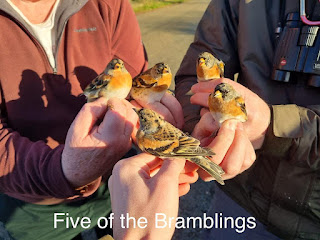
Bramblings are a brightly coloured Scandinavian finch closely related to the Chaffinch and a regular winter visitor to the UK, but not necessarily Stanford. In recent weeks there have been up to 20 reported feeding among the Chaffinches, but that is nothing compared to some flocks of several hundreds reported at other sites in the Midlands.

On Sunday 30th January, Mick, Theo and I took advantage of the short spell of good weather to spend a morning ringing on the 'Top Road'. It was a cold misty morning on arrival and we quickly set up a line of four nets. Soon after the mist cleared, finches started to gather to feed on the road and grass verge in good numbers of up to 50 birds at a time.

A handful of Brambling could already be picked out amongst the numerous Chaffinches. Our first visit to the nets took us all by surprise when we found 10 Bramblings, our highest catch since the winter of 94/95! 

We caught another two by the end of the morning, along with 15 Chaffinches, one Goldfinch, one Icelandic type Redwing, one Blackbird, four Blue Tits, two great Tits and a retrap Nuthatch.


As you can see from the photos, above, occasionally there will be a bumper crop when they will be almost peanut size. These are called 'mast years' and should occur every 5-10 years.

AGH


Friday, 17 December 2021

Sand Martins at Stanford

We are now the proud possessors of two new bespoke spanking new Sand Martin Cabinets at Stanford Reservoir, with room for 96 pairs. The main funding for this came from Tarmac's Landfill Communities Fund, plus a 10% contribution from the SRG. The project was supported by Severn Trent, so thanks also to our ranger Ian Martindale and to the Senior Biodiversity Manager Zara Frankton who have encouraged us throughout. We chose a site which is currently underutilised with expansive views over the water, 10 minutes walk from the dam carpark, heading towards Blowers' Bay:
Preparing the site

The cabinets were supplied by Green Future Building, a Social Enterprise company. The van arrived on the 30th November, and promptly sank into the Stanford mud. Many thanks to Ian Martindale who spent an unplanned morning ferrying parts along the track for construction in his 4 by4 and thanks also to Chris Begley who was dragooned into action.
Under construction, showing the chambers for nests


Completed, looking towards the Point  

Despite this setback, the banks were completed on the same day, finishing by 1500. The grand unveiling took place on 16 December, a bright point in an otherwise rather grim year. Mince pies and mulled wine were supplied, but everyone behaved themselves. Present luminaries included Mick (Group Leader), Adam (Secretary), Dave (Treasurer), Dawn (SRG member), Mike Alibone (ex Northants County Recorder and blogger), Ian (ST Ranger) and Chris Hubbard, local birder to the gentry. Special thanks to Jamie Prpa of Tarmac, without whom the project could not have proceeded. 


From left to right: Ian, Mick, Adam, Dawn, Jamie, Dave

Come March, we are looking forward to the arrival of our Sand Martins. Fingers (and any other relevant parts) crossed that they take up residence, a great boost for biodiversity at Stanford!

Friday, 12 November 2021

Autumn Has Arrived

'All the leaves are brown, and the sky is grey'; well that's about the only similarity we have with the Mamas and the Papas, but the autumnal winds have picked up and it has been wet too. Now that Adam our eminent group secretary has retired, he and Mick have been working hard at mid week ringing, in addition to our regular Saturday sessions. In September we ringed 2248 birds and in October 937, reflecting the departure of our migrant warblers. On the other hand we are now starting to get decent numbers of Redwings and a few Fieldfare to boost totals. This is also a good time of year for rarities, but the winds have been all wrong! Ideally they would be from the north-east, bringing birds down from continental europe, but sadly they have been largely from the west, blowing not much in from the Atlantic (apart from rain). However, we still have had some if not actually rare, then certainly unusual birds for the site, turning up in our nets. These include a Skylark, Magpie and Kestrel, which have helped to increase our annual species account to 59. All birds are good, but saving the best to the last, we have also ringed a very nice male Brambling:
And lastly, a once per year, if we are lucky visitor, this spanking Yellow Browed Warbler:
I wonder what is next?