Tuesday, 6 June 2023

Early Summer Round Up

Spring is now over with its rain and winds and we are now into summer, still with the wind, but no rain... so probably an improvement. The mighty SRG have rallied to the cause and we are all enjoying the regular Saturday and occasional midweek sessions. The days are still lengthening, but we (almost) relish the 0430 starts and the cold mornings. Surely it will warm up soon? So far we have ringed 791 birds of 31 species, a good start to the year.

Our residents are busy producing their young, and we are starting to pick up the occasional juvenile. Most of the tit boxes on both sides of the reservoir have produced good numbers. It is always nice to see young Robins fledged and getting ringed: 

To make the most of the long northern summers, our breeding warblers have returned, with the sad exception of Grasshopper Warblers who seem to have forsaken us as a breeding bird this year. All the others are back.


Sedge Warbler- newly returned

It is particularly nice to see birds we ringed in previous years returning to Stanford. Thus far, the number of returns are: Lesser Whitethroat 1, Blackcap 5, Sedge Warbler 6, Garden Warbler 8, Willow Warbler  10, Chiffchaff 11, Whitethroat 20 and Reed Warbler 28. 

Reed Warblers overwinter in West Africa. The challenges of flying and navigating 3,500 miles for a bird which only weighs 10 grams are fairly mind boggling, so we are always delighted when they arrive. The oldest returnee so far was ringed as an adult in 2017, therefore has made the journey at least 13 times, meaning that it has covered in excess of 45,000 miles. When I first drafted this blog, I checked my calculations twice, as it seems such an outlandish number, but what an amazing feat. To finish off, here is one of our favourite birds. also recently returned from Africa, from just south of the Sahara!

Lesser Whitethroat, always a delight!

Monday, 8 May 2023

Back in Business in 2023

 We are now back to our usual activities, ringing on Saturdays, plus midweek sessions from the SRG (Senior Retired Gentlemen). As I write, it is lovely to see our warblers arriving, and we have now ringed good numbers of Blackcap, Whitethroat, Chiffchaff and Willow Warblers, with smaller numbers of Lesser Whitethroat, Garden Warbler, Sedge Warbler and Reed Warbler.

It is particularly nice to see birds we ringed in previous years returning, Whitethroat and Chiffchaff seem to be very site faithful. Anyway, they are all singing at the tops of their voices, and generally getting on with producing the next generation of birds. Excellent.

Unfortunately Grasshopper Warblers have not been heard or ringed. It would be a shame to lose these as a breeding species, although numbers elsewhere are good. However, we have ringed, a couple of unusual species (for Stanford anyway). At the Lodge, a Mistle Thrush nest was spotted by Steve, one of our sharp eyed birders. Thanks to Jim, the owner, we were able to access the nest and extract the only pullus and ring it:

Only the third Mistle Thrush ringed at Stanford, and the first since 1984! The other unusual bird was this Mallard:

The first since 2011! It was found grazing scattered seed at the feeders with a drake, and flew up directly into a net, to be promptly extracted by Mick. Of the two, I don't know which was the most surprised.

These two birds make up for a slightly slow turnout this year, so it is all to play for; autumn is really the time for Stanford to shine, so we are hoping to rack up a good number of species in 2023.


Wednesday, 25 January 2023

Annual Report 2022

The latest annual report is now available from our website, Stanford Ringing Group (stanfordrg.org.uk)  (always worth a browse), or directly from 2022-annrep.pdf (stanfordrg.org.uk)  Enjoy.

'Very impressed, I couldn't put it down!'


Monday, 23 January 2023

Scrub Bashing Starts Again!

Many people are surprised by the number of warblers ringed at Stanford. In part it is due to the enthusiasm of the ringing team, who put in the hours of ringing that produce such valuable data. However, the team also put in many hours of habitat maintenance or scrub bashing as it is locally known, during the winter months. If left unmanaged the wetland area around the reservoir would turn from reeds and bramble to blackthorn and willow and eventually wet woodland would emerge. Many warbler species nest in low level vegetation so, unless woody vegetation is cut back, the numbers of breeding birds here would quickly decline. From January through to early April, instead of ringing, we turn up on a weekend morning armed with loppers, bowsaws and, for those who are licensed to use them, chainsaws, to work on site in anticipation of our summer visitors. 
Saturday started cold and frosty but at 8 am a team of 11 ringers and local volunteers arrived at the railtrack to start work. After a warming cuppa and brief chat, we split into teams to cut back the rampant blackthorn and encroaching willow and hawthorn. The sound of chainsaws soon reverberated around the reservoir. 

Beth suitably attired for hard work. A range of malcontents and recidivists in the background

One team, led by Adam, started a fire with donated cardboard and scavenged ash, which burns well even when green. Others used hand tools to attack the blackthorn.
Thick leather welding gloves are essential for this job to keep out the inch long thorns. Some of us dragged felled branches along the path to feed the fire. It was certainly warm work and good exercise. The fire soon gained enough heat to burn even the wet green willow.

Adam tends to the fire; very welcome on a cold morning

Regular tea breaks kept us going for nearly four hours and by the time we finished we had transformed an area so that that little remained above head height, except a few elegant birch trees.
Weather permitting, we will be repeating this every weekend until April in preparation for the
return of the migrant warblers and a bountiful ringing season in 2023.

Unceasing toil at Stanford!

Do you feel you could work this hard? We are always looking for volunteers to help us, contact details can be found on our website Stanford Ringing Group (stanfordrg.org.uk)
Posted by Kate M

Sunday, 11 December 2022

Winter Ringing at Stanford

 A cold snap has hit the UK, but a mere detail like that is as nothing to the boys and girls of the mighty Stanford Ringing Group!

On Saturday 10th December, the temperature varied from a decidedly nippy -3 degrees C, to a comparatively balmy +1. Not put off, a large team met up at 0600. Dawn and Beth went to the Paddock, whilst Adam, Dave, Jade, Jo, Stuart and Peter met up on the rail track. Battling with frozen guys  and sub zero metal polls, we put up nets from Safari to Box 16, plus the Paddock giving a total of 27, a mammoth undertaking. Despite the cold, it was a sunny morning with very little wind, so it perhaps wasn't quite as challenging as this photo might suggest:

Dave, Stuart, Adam, Jade and Jo in full winter plumage

The first round was very productive, with a good number of thrushes, both resident and winter visitors:

A nice selection of our thrushes: (L to R) Redwing, female and male Blackbirds and Fieldfare

It is particularly nice to have decent numbers of Fieldfare; the total for 2022 is 24 so far, in comparison to a decidedly meagre single bird in the previous year.

The totals from both locations were, for new birds: Wren 2, Dunnock 1, Blackbird 11, Fieldfare 2, Song Thrush 3, Redwing 23, Blackcap 1 and Reed Bunting 3. We were really pleased to re-trap a number of our resident species, who seem to be surviving the cold weather very well, these were: Wren 7, Dunnock 4, Robin 9, Blackbird 3, Cetti's Warbler 2, Long Tailed Tit 2, Blue Tit 7 and Great Tit 3. Also, we had a re-trap Yellowhammer, which is a very rare event- the first since 2001!

Well 2022 is drawing to a close, and in many ways it has been a horrible year, but nothing puts off our birds as they go through their lives, perhaps a lesson for all of us. Last words go to one of our residents:

'Merry Christmas, see you in 2023!'


Friday, 2 September 2022

Stanstock III: A Great Gathering of the Group at the Reservoir


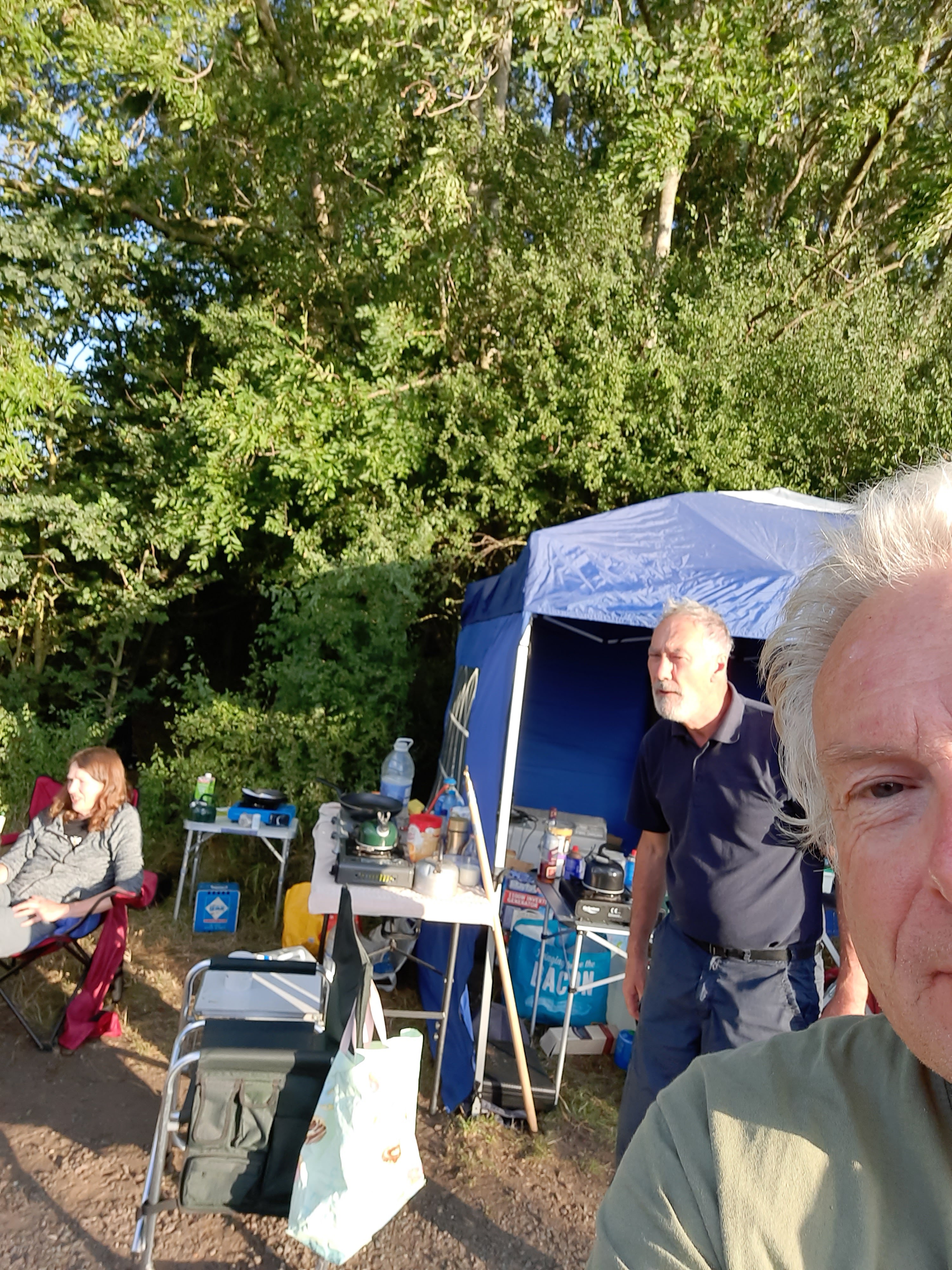
Our annual celebration of migration is nominally scheduled for the last whole week of August, leading up to the Bank Holiday. The Gods of Ringing smiled upon us this time, and we had decent weather from Saturday 20th through to Tuesday 30th, so we ringed pretty solidly for 11 days. This was backed up by a good turnout of SRG members, so in addition to Railtrack, for part of the time we had two ringing stations, covering the Railtrack and Point; about 27 nets. As before, a contingent camped out supplemented by day visitors. It is no exaggeration to describe it as a walloping great success!!

Jade, Heather and Kate look industrious


Stuart and Dawn look chilled


Kate, Adam and Peter look... not sure of the correct adjective

The full species count for new birds was: 

Blackcap 1394, Whitethroat 409, Sedge Warbler 349, Willow Warbler 285, Reed Warbler 178, Robin 93, Lesser Whitethroat 72, Garden Warbler 70, Chiffchaff 49, Grasshopper Warbler 40, Blue Tit 27, Redstart 14, Wren 12, Goldcrest 10, Swallow 9, Long-tailed Tit 8, Reed Bunting 7, Blackbird 5, Song Thrush 5, Cetti's Warbler 5, Stock Dove 4, Whinchat 4, Linnet 4, Spotted Flycatcher 3, Great Tit 3, Sand Martin 2, Dunnock 2, Bullfinch 2, and single Tawny Owl, Pied Flycatcher, Wryneck , Nuthatch, Treecreeper, Tree Sparrow, Chaffinch, and Goldfinch!

A young Tawny- great way to start the week

Very smart juvenile Whinchat

Juvenile male Pied Flycatcher


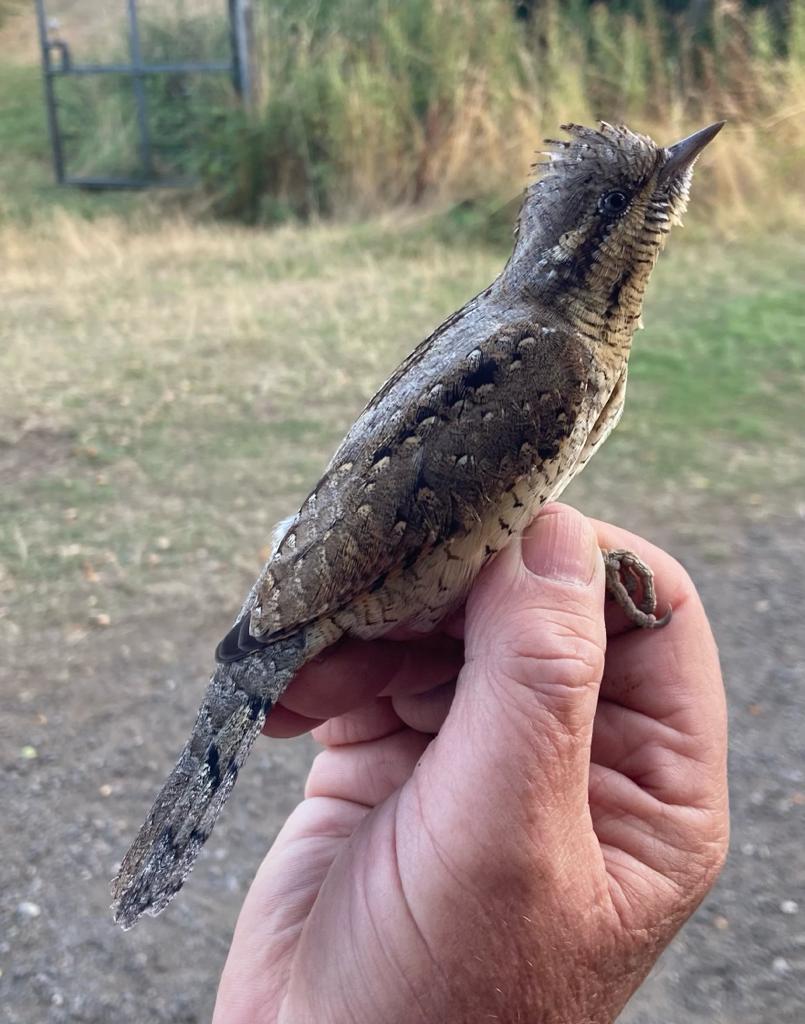
What is getting to be an annual event; Wryneck- a great way to finish the week.

So that is a total of 3,067 new birds, plus 422 retraps and 14 controls over the 10 days, beating last year's new bird total of a mere 1795 by a whopping 1272! Origin of the controls will be confirmed in the annual report due out at the end of January; look out for it on stanfordrg.org.uk
Time for a well earned rest... only joking, time to go out ringing once again!


Thursday, 14 July 2022

Great Morning at the Reservoir

We usually ring on a Saturday, weather permitting. We have recently had a number of excellent sessions, and been moving around the site, starting to ring lots of juvenile birds; our resident birds seem to be having a really good season. These sessions are augmented by midweek ringing, usually with Mick or Adam, both retired, both keen.

Tuesday 12 July was designated as a mid week excursion, and as if by magic, suddenly a big chunk of the team were available! So... Mick and Adam set up in the Paddock, Stuart and Kate ambled over to Blower's Bay, and Dave and I, plus Jade our new trainee, donned waders and staggered into the Leics reedbed.

Everyone had a good morning, M&A ringed 87 new and retrapped 18, S&K ringed 45 new and retrapped 18. These were a good representative bunch of pretty much what we would expect at this time of the year, good numbers of Blackcap, Robin, Chiffchaff, Sedge, Reed and Garden Warblers and sundry others. Very nice.

Over in the reedbed, much to everyone's surprise, things were afoot! Firstly, we ringed a slightly drab 3J female Nuthatch, which was a ringing tick for Jade, as well as being a bird that we don't necessarily catch every year. This was in fact the first for the year! 


At Mick's suggestion, Dave and I put up a 40' two shelfed net out to a patch of shingle, exposed as the water level has dropped. At 0900 I went out and found a large brown bird next to the shore! I promptly extracted it and brought it back:


Wow! the first Moorhen since 2009, and a full adult to boot! I don't think that Jade could believe her luck as Dave helped her put an F ring on, jammy is perhaps the term that springs to mind:


That made it a brilliant session, two new species for the year and loads of Reed and Sedge Warblers. Come 1100 it was time to take down the nets as it was getting warm, and Dave was in need of beer. The final net to come down was a 60' in the scrub leading up to the ringing station. As I trundled over, Jade appeared in a state of agitation- there was a possible bird of prey in the net, let's get a move on! Cripes, what was it? Most likely it would be a Sparrowhawk (we get 2/3 per year), which would be good. Less likely it would be a Kestrel which we get every couple of years, which would be brilliant!
But no, it was something else...


Triple cripes, it was a Hobby, the only one ringed at Stanford ever! Ever! These catch dragonflies and hirundines in mid air for a living and are amazing birds, so quite what it was doing in the lower shelves of a mist net tucked into scrub is a bit of a mystery. Anyway, after some mild exclamations of surprise, I extracted it, which was fun and a bit pecky. Back at the ringing station I asked Dave if he fancied putting a ring on it. He thought about it a bit and decided that on balance he probably did. What a bird! Quite small, but very solid and muscular. We aged it as a five (hatched last year) male:


So that was the third new species for the day. We ringed a total of 80 plus 32 retraps. So the group en masse ringed a grand total of 212 new and 68 retrapped. What a day!
Peter N